Based at the IT University of Copenhagen, the section of Technologies in Practice conducts qualitative studies of technologically mediated practices in organisations and everyday life.
The vast majority of societal challenges demand critical engagement with contemporary technologies.
Our interdisciplinary environment provides students and researchers with the resources necessary for analysing entanglements of the social and technical with and through IT.
News
TiP Summer Event
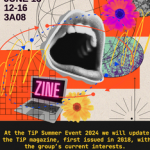
In 2018, editors Christopher Gad, Brit Ross Winthereik and Sisse Finken brought you the TiP Magazine which presented research in the group through the unfamiliar genre of the glossy magazine, twisting and tweaking well known elements like the travel report, recipe and so much more. The TiP magazine was a one off. In 2024, we […]
Tea in TiP with Kirstine Lund Christiansen
Tea in TiP is a series that started a decade ago, where we interview guests who have come to spend time with us, about their projects and activities.The following took place by email in the Spring of 2024, between Rachel Douglas-Jones and Kristine Lund Christiansen, a guest hosted by James Maguire. Hi Kirstine, […]
TiP on Mastodon
- UntitledVast turn out for the DIGI-FRONT Symposium at Goldsmiths, London, with Irina Papazu welcoming an international audience
- UntitledBook launch Monday 26.1.26 at 13:30-15 in ETHOS Lab, IT University of Copenhagen! https://billetto.dk/en/e/book-launch-the-smartification-of-everything-critical-perspectives-in-sciences-arts-and-society-billetter-1790120
Research
We are an interdisciplinary group, with a shared interest in qualitative studies of technologically mediated practices. Our work is funded by the Danish Research Council, European Union's Horizon 2020 program, Carlsberg Foundation, Innovation Foundation, Novo Nordisk and the Velux Foundation.
Teaching
We closely integrate our role as educators with our work as a research group. Our international faculty use insights from around the world in their teaching. Our teaching draws on disciplinary backgrounds such as information studies, history, anthropology, sociology, and critical computer science. We aim to help students address the critical questions arising at the intersection of society and technology.